
Because "just focus on your breath" is, frankly, not the instruction you need.
You finally book the class. You show up. You unroll your mat.
And then the teacher says "now let your mind go completely quiet”… Perfectly on cue, your brain decides that’s the perfect moment to remember you haven't replied to that email from three weeks ago, wonder whether octopuses dream and mentally redecorate your living room. All at once.
Sounds familiar?
If so, please know you're not broken! You're just wired differently, so your ideal yoga class may be a little different too.
The truth is, most group yoga classes are not designed with your particularly sparkly brain in mind. But here's the thing: yoga done your way might actually be really good for your nervous system, your ability to regulate emotions and your relationship with your own body. The research backs this up. And the lived experience of many ADHDers does too — including me!
So let's talk about how to actually make it work.
You don’t have to force yourself to be someone you're not. You just need to adapt a few things when no one else is doing it for you. Actually, you might even need to be a bit more of your fun self to harness the benefits of such a powerful practice…
I’ll explain.
First: what actually makes group yoga hard when you have ADHD?
It helps to name it, because this isn't just a focus problem.
Sensory overload. The music, the incense, the temperature, the person next to you breathing loudly — it can all add up fast. Your nervous system is already working overtime just making it to class at the right time.
Instruction processing. When a teacher rapidly chains five cues together ("inhale, step your right foot forward, ground through the outer edge, open your arms, gaze up"), your brain might still be on "step your right foot forward", while everyone else has already landed in Warrior II.
Restlessness during stillness. Long holds and slow flows can feel like torture when your body is craving movement and your brain is craving stimulation. That peaceful lying-down bit at the end, savasana, is notoriously the hardest pose for ADHDers — and, honestly, for a lot of neurotypicals too.
Time blindness in motion. You might go deep into a pose and lose complete track of the sequence. Or space out mid-flow and resurface three poses later, unsure of where your body is supposed to be.
Comparison and shame. In a group setting, it's easy to glance sideways and feel like everyone else has it: the stillness, the elegance, the quiet mind. That comparison spiral is real, and it can yank you out of your own experience faster than anything.
None of this makes you bad at yoga. It makes you someone who needs a slightly different setup. And! possibly a few reframes of what yoga is actually asking of you.
Before the tips: two things yoga teachers say that deserve a closer look
"Still your mind."
This is probably the most repeated instruction in Western yoga. And it's also one of the most misunderstood.
Here's the thing: yoga philosophy never said your mind should go quiet. In fact, the Yoga Sutras (the foundational text of classical yoga) describe the practice as observing the movements of the mind, not stopping them. The goal is witnessing, not numbing.
What this means in practice: when thoughts arise during your class (and they will), you are not failing. You are getting a live demonstration of what your mind does. The practice is 1: to notice (oh, there's a thought about the email, there's a thought about dinner, there's a thought about octopuses) and 2: gently return your attention to the body, without making any of it mean something bad about you. Actually, add 1.5: congratulate yourself for noticing where your mind just went. How insightful of you! Then, move on. More thoughts will come, more will go. Such is life.
For an ADHD brain, this is actually a deeply honest practice. Your mind is very, very active. You don't need to pretend otherwise. You just need to watch it with a little more lightness.
So the next time a teacher says "still your mind," translate it internally to “observe your mind”. Let it do what it does. Stay curious about it. That is the actual instruction. It is one that we inquisitive minds are actually particularly capable of following.
"Inhale and move."
Here's something that took me quite a few yoga classes to realise, that more people should know: you don't have to breathe and move at exactly the moment the teacher cues it.
The instruction to link breath and movement (especially in Vinyasa classes) is meant to be an invitation to bring your awareness to both at the same time, so that the pose is a little less mechanical and a little more alive. It is not a musical chair situation where you must be seated before the beat drops.
Your breath moves at its own pace. And if the teacher cues a transition while you're mid-exhale or while you're still finding stability in your current pose, you are completely allowed, if not encouraged, to wait for your next natural breath. To let the movement arrive with the breath rather than forcing the breath to arrive on command.
This is especially useful for ADHD brains because the pressure to keep up can send you into your head and out of your body. Which is the exact opposite of what yoga is for.
If you need an extra breath before the next movement, take it. If you need to stay in the previous pose a moment longer because you've only just found your feet, stay there. The pose is not the point.
The breath, the energy changing course through your body is. Allow it to flow.
Also, I promise you: nobody in the room will probably even notice. Just as you focus on your moves, they focus on theirs. Some advanced practitioners even skip steps entirely in favour of listening to their bodies.
10 concrete and honest tips
1. Arrive early, on purpose
I know, you might stress out about even making it on time for class. And here I am asking you for extra effort. But hear me out:
When you arrive with 5-10 minutes to spare, you get to choose your spot in the shala (more on that below), set up your props without rushing and let your nervous system settle into the space before the class starts. Walking in late (or even exactly on time) often means starting the class in a mild stress response. Your ADHD brain will spend the first 15 minutes of the class trying to catch up with the pace and actively slow down your hurried breath instead of actually arriving.
Give yourself the gift of a few extra minutes on the mat before the teacher starts teaching. By the way, you don’t need to stand still in the meantime if you don’t want to. By all means, move and stretch your body. Play.
2. Choose your spot strategically
TL:DR; Front row or the very back. Almost never the middle.
Front row: you can see the teacher clearly, you're less likely to be distracted by other sounds or other people's bodies in your line of sight. Great if you tend to lose track of the sequence too. This is my preferred option.
Back corner: you have full view of the room, no one is behind you, and you have the spatial freedom to feel slightly more "off the grid." Great if you get self-conscious or overstimulated by being watched.
Avoid the middle of the room if you can. You'll have people on all sides, which tends to multiply sensory input and makes the comparison spiral so much easier to fall into.
3. Use props as anchors, not just supports
Blocks, bolsters, straps — most studios have them and most ADHDers underuse them. Beyond their physical function, props can act as anchors for your attention. For example:
Having a block under your hands in a forward fold gives you a tactile landing point. Holding a strap in a seated stretch gives your hands something to do. The physical sensation of a prop can actually help ground your awareness in your body rather than letting it drift off somewhere between your to-do list and a half-remembered conversation from 2019.
If your hands are free and your mind is wandering: pick something up.
4. Give yourself permission to modify constantly
Not as a fallback. As a practice.
If the class is moving too slowly and you're getting restless, quietly pulse in a pose, micro-move your fingers, or do a slightly more dynamic version of what the teacher is offering. Better yet, you may even mentally go through all the alignments you remember you need in the pose, to get your body in the most active and pleasant position.
If the class is moving too fast and you've lost the thread, drop to downward dog or child's pose, reconnect with your breath and rejoin when you're ready. If you're still settling into a pose when the teacher moves on, you may stay where you are for one more breath. Let the sequence flow around you for a moment. Then join back in.
This is not cheating. This is body autonomy. It's also, arguably, the more advanced practice: knowing yourself well enough to honour what you actually need, in real time, in a group context. Your mind and body will thank you.
5. Let your breath lead, not the clock
This is the practical version of what we talked about above.
When you feel the urge to rush through a transition because everyone else is already in the next pose: pause. Take one full breath. Then move.
The class will not fall apart. Your body will not fall behind in any meaningful way. And you will arrive in the next pose with your awareness intact, which is worth infinitely more than arriving there half a second faster with your mind still back on the mat.
Yoga is not a race. It is also not a synchronised swimming competition. You being half a breath behind is completely invisible to everyone else and deeply valuable to you.
6. Find a sensory anchor for your wandering mind
When the cue is "focus on your breath" and your brain immediately decides to focus on literally anything else, a backup anchor can help.
Some ideas that tend to work well for ADHD brains specifically:
Physical sensation: press your feet into the mat. Really feel it. Almost like you’re grabing the ground with your toes. Feel the arch of your foot activating as a result. Feel the four corners of each foot too. That's concrete, immediate, and difficult to mentally escape from.
Sound: pick one specific element of the music or the teacher's voice and follow it like a thread.
Counting: inhale for four counts, exhale for four. Gives the task-oriented part of your brain something to do.
A short internal phrase: something to return to, such as “I am here”, “I am”, “I inhale”, “I belong”. Repetition is grounding.
You don't need to stay on the breath just because that's what everyone else is doing. You may need something extra to come back to. Find your anchor and let yourself return to it as many times as it takes.
7. Reframe what "keeping up" actually means
ADHDers often leave a yoga class having mentally catalogued everything that went wrong. The transitions they missed. The pose they wobbled out of. The moment they got completely lost and had to look around the room for clues.
Here's a reframe: keeping up, in yoga, means staying present. Not keeping pace.
If you stayed in child's pose for three rounds while the class moved through something you weren't ready for, and you stayed present in child's pose, breathing, noticing, not on your phone, congratulations! You did yoga. Fully.
If you paused to take an extra breath before every transition and arrived in each pose a beat later than the rest of the room, but you arrived with awareness, with your feet actually feeling the floor: you did yoga. Better than someone flowing through the sequence on autopilot.
If you’re feeling brave, you may also give yourself the challenge to notice yourself lose balance in class at its very beginning. Notice the seed of your shift. Notice yourself as you wobble. And see if you can reorient the body gently without completely giving up on the pose.
The pose is the vehicle. The awareness is the point. You can be a slow vehicle and still arrive exactly where you're meant to.
8. The savasana problem
Savasana, the lying-down relaxation at the end of class, is often described as the hardest pose. For ADHD brains, it can genuinely feel unbearable.
Your body is still. Your mind is not going to be. That's just neurology.
A few things that help:
Give your hands something. Rest them on your belly and feel it rise and fall. That light tactile input can help.
Use a blanket or eye pillow over your eyes. The weight and darkness can be genuinely calming for an overstimulated nervous system. And the lavender eye pillows some yoga studios have are divine.
Don't try to clear your mind. This is where the “observe, don't numb“ principle becomes most useful. Let your thoughts run. Watch them, loosely, like you're watching a slightly chaotic river from the bank. You don't have to make it quiet. You just have to stay in the room with it.
If you genuinely can't stay still, it's completely okay to slowly, quietly move. For example, you can roll your ankles softly or rock gently. (And again, don’t worry, you're not disturbing anyone.)
The goal of savasana is integration. Your body knows what to do, even when your mind is off on an adventure. This is the ‘being’ part of the practice, after a whole lot of doing. How luxurious to just notice yourself being you for a while! No chore, no urgent need, no fuss.
9. Build a tiny pre-class ritual
ADHDers generally do better when we can transition into something on our own terms, rather than being thrown in cold.
A small ritual before class, even just two or three minutes, can help shift your nervous system into “this is intentional, body-led time” mode. It doesn't have to be elaborate:
Walking to the studio without headphones in
Sitting in your car for two minutes before going in
Doing five slow breaths in the changing room
The ritual signals to your brain: “we're doing something different now. Come in”.
10. After class: notice before you evaluate
Before you reach for the verdict on how it went, try noticing first.
Did your body feel different after than before? Even slightly? Did you breathe more slowly at any point? Did you feel, even for a moment, present in your body?
That counts. That is, actually, the whole point.
And while you’re reflecting with no rush, feel free to sip on a cup of tea if you have the time and just settle into your own body again — the same body you’ve known, yet maybe a bit different this time. Take in the experience you’ve been through and be with it kindly. Or curiosity. Or buzzing with enthusiasm.
A note, from one ADHDer who also teaches yoga
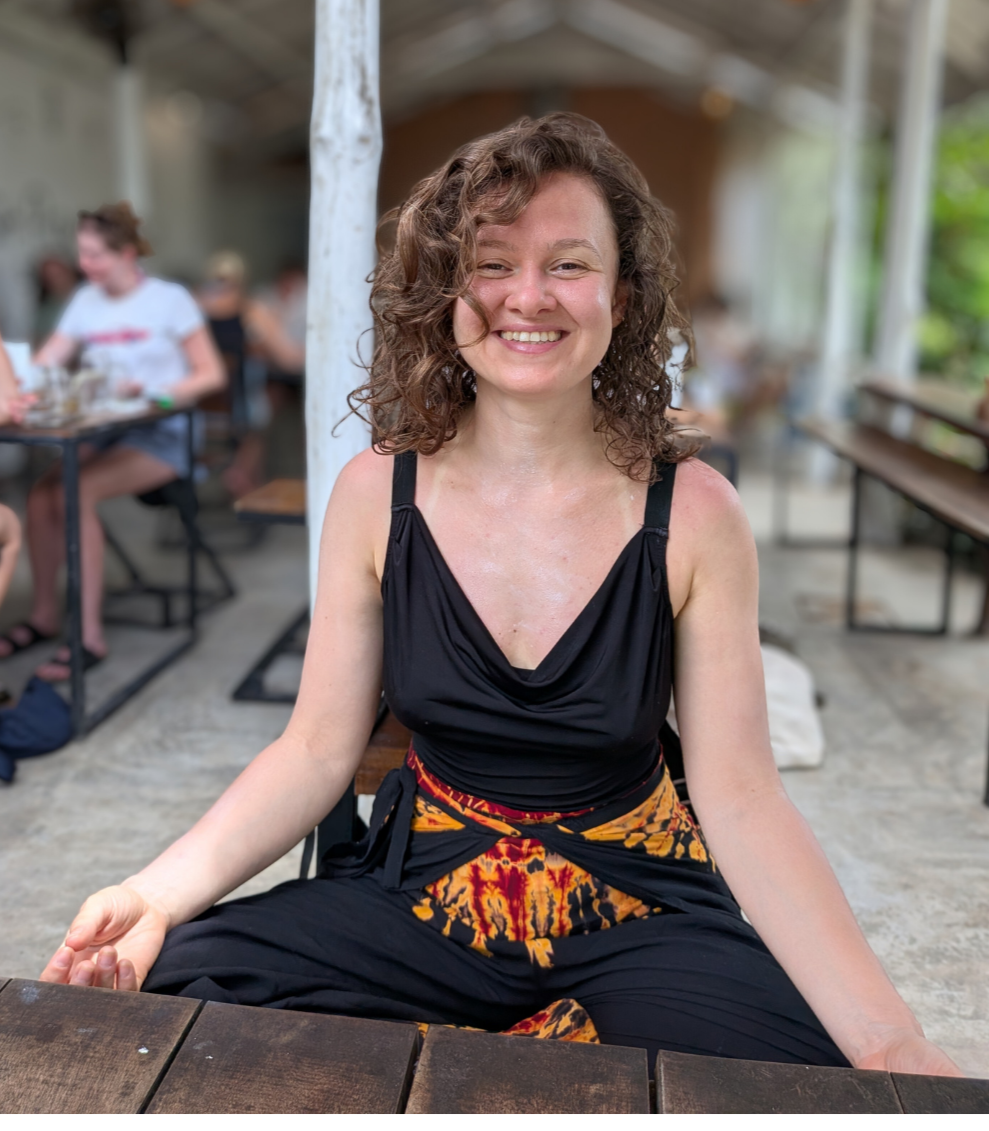
I know what it's like to be in a room full of people who all seem to have this figured out, while your brain is bouncing off the walls trying to settle. I know what it's like to leave a class feeling like you did it wrong.
But yoga does not ask for a quiet mind. It never did.
It asks for honest presence. And that, your brain is entirely capable of, in its own rhythm. (It might even be better at it than you expected, considering how sensitive you might be.)
If you want something that's already designed around your brain, your energy, your nervous system, your particular kind of magic, then that's what my yoga sessions are built for. No group pressure, no keeping up and definitely no boredom. Just a practice shaped around how you actually move through the world, as a neurodivergent person. Online or in-person.
Or, if it's your whole life that could use a little redesign, not just the yoga mat part, I also offer some special coaching programs.
Come on in, have some tea! 🫖
